
What Really Controls Oil Prices?

(Forbes) World oil prices are controlled by the amount of crude oil stored at Cushing, Oklahoma. That’s because Cushing is the pricing point for WTI (West Texas Intermediate) oil prices, the most-traded oil futures contract in the world.

Cushing Storage Rules World Oil Prices.

WTI (and Brent) oil prices have good negative correlation with the volume of crude oil stored at Cushing.

Posted On :
Category:

U.S. shale’s message for OPEC: above $40, we are coming back

(Reuters) For leading U.S. shale oil producers, $40 is the new $70.

Less than a year ago major shale firms were saying they needed oil above $60 a barrel to produce more; now some say they will settle for far less in deciding whether to crank up output after the worst oil price crash in a generation.

Their latest comments highlight the industry’s remarkable resilience, but also serve as a warning to rivals and traders: a retreat in U.S. oil production that would help ease global oversupply and let prices recover may prove shorter than some may have expected.

Posted On :
Category:

Total president on investment crunch

“The problem is going to be the money. Where is the money going to come from? A lot of people who have burned their fingers on (U.S. shale) are going to be reluctant to reinvest.”

Arnaud Breuillac, president of exploration and production at French oil giant Total.

Posted On :
Category:

Peak Oil Review – 29 Feb 2016

Oil had a good week for a change with New York futures rising 3.2 percent to close at $32.78 and London climbing 6.3 percent to close at $35.10. This time, there was more than just wishful thinking behind the price increase as pipeline outages shut in 600,000 b/d in Kurdistan and 250,000 b/d in Nigeria to cut global exports by 850,000 b/d. In both cases, it is unclear as to just when the pipelines will reopen. In Nigeria, the outage was due to an underwater leak while the situation in Kurdistan likely is related to one of many wars taking place in the region.

Posted On :

Why Oil Booms And Busts Happen

(oilprice.com) What if I told you that there was a period in history where oil demand declined by 5 million barrels per day and non-OPEC supply increased by 5 million barrels per day, yet oil price rallied more than 50 percent? Would you believe me?

If your answer is yes, then you guessed right. This was the period from 1979 to 1985; it was a period during which global oil demand declined from over 61 million barrels to 56 million barrels and non-OPEC supply increased from 32 million barrels to 37 million barrels. Yet prices rallied from $17 a barrel in 1979 to $26 a barrel in 1985, while reaching as high as $35 in 1981.

Posted On :
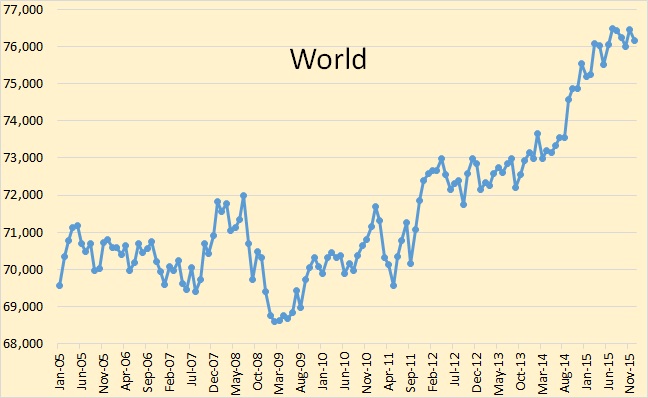
JODI World C+C

Oil Price And Its Effect On Production

(peakoilbarrel.com) The JODI Oil World Database came out a few days ago. The data is through December 2015. The JODI C+C production numbers differs somewhat from the EIA numbers. The JODI OPEC numbers are crude. Also there are a few very small producers that do not report to JODI so their numbers will be slightly less than the EIA. But otherwise they are pretty accurate.

Also, JODI, for some reason, does not count all of Canada’s oil sands production. So for Canada I use Canada’s National Energy Board numbers instead.

Posted On :

Why Oil Fell To $30

(Forbes) One of the questions I am most frequently asked is “What factors led to the precipitous drop in oil prices?” Some have suggested that this is all OPEC’s fault, while others have blamed either surging U.S. shale oil production or falling demand.

I addressed the demand issue back in December in The Fallacy of Peak Oil Demand . To summarize, since 1983, annual global demand for crude oil has only fallen twice; a small decline in 1985 and another decline in 2009 in response to the financial crisis. The growth rate for crude oil has been remarkably consistent, adding an average of almost exactly a million barrels per day (bpd) for more than 30 years.

Posted On :
Category:

IEA warns consumers of spike in oil prices

(BBC) The International Energy Agency (IEA) is warning consumers not to let cheap oil lull them into a false sense of security amid forecasts of a price spike by 2021. In a report , the IEA said it expects prices to start recovering in 2017. But it forecasts that will be followed by a sharp jump in price as supply shrinks following under-investment by struggling producers.

Brent crude touched a 13-year low of $28.88 a barrel in January. It has since recovered somewhat, but is still far below a high of $115 in June 2014. On Monday the price was up around 4.9% at $34.62.

Posted On :
Category:

U.S. Banks Growing Hesitant To Loan Money To Energy Firms

(oilprice.com) BNP Paribas, France’s largest bank, announced that it would no longer lend money to struggling oil and gas companies in the United States. “Given the current environment in the oil and gas markets and the short to medium term outlook, BNP Paribas has decided to halt the redevelopment of its reserve-based lending business,” BNP said in a statement. The bank will continue to work with its existing borrowers, but won’t lend to new ones.

The French bank was concerned that default rates among energy companies would rise, sources told Reuters. It was the second time that the bank pulled out of lending to energy companies in the U.S. – it sold a unit to Wells Fargo in 2012 before reentering the space in 2014 when oil prices shot into triple-digit territory.

Posted On :
Category:

Molson Coors says weak economy affecting beer sales in oil-producing provinces

(Toronto Sun via Reuters) Oil workers just aren’t drinking like they used to. Molson Coors Brewing Co. blames a sluggish economy for a big drop in beer sales in Alberta, Newfoundland and Labrador, and Saskatchewan. Customers are abandoning higher-priced premium beers for economy brands, the beer giant says.

“The consumer is under pressure,” Stewart Glendinning, chief executive of Molson Coors Canada, said Thursday during a conference call on the company’s fourth-quarter and 2015 results.

“And if you add to that the fact that consumer debt in Canada is at an all-time high, it’s made for quite a difficult recipe in some of those provinces.”

Posted On :