
Category:

Oil prices slip as short-covering rally fizzles

(Reuters) A worker walks at Nahr Bin Umar oil field, north of Basra, Iraq December 21, 2015. Oil prices dipped on Friday, ending a two-day rally, as a glut of crude and refined products weighed on markets and investors eyed a possible stutter in China’s imports.

U.S. West Texas Intermediate (WTI) crude futures CLc1 fetched $41.74 per barrel at 0930 GMT (0530 ET), down 19 cents from their last close, after trading as low as $41.44 earlier in the day. They were on track roughly to break even on the week.
Posted On :
Category:

Oil prices plummet amid continued oversupply, with no end in sight

(The Guardian) A crude oil importing port. Oil may be a precious and dwindling resource, but at the moment, at least, it looks like we just have too much of it. Crude-oil prices are now at their lowest since early April, hit by continued oversupply, concerns about global demand and negative price sentiment by oil-market participants. And that situation looks likely to continue in the near future.

Posted On :
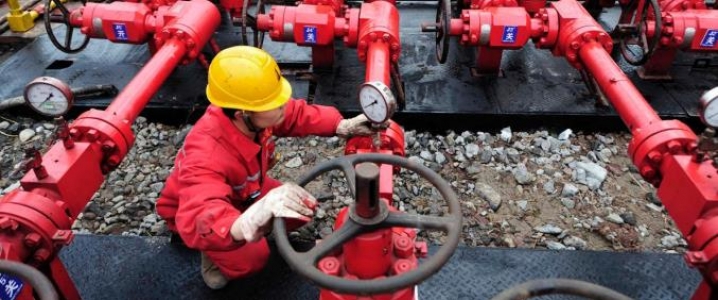
Sinopec employee
Category:

Oil Correction Stalls On Strong Dollar, Rising Rig Count

(oilprice.com) Oil briefly dropped below $40 per barrel this week but rebounded following the surprise drawdown in gasoline inventories, a robust decline of 3.3 million barrels. Oil traders were more than happy with that result, ignoring the 1.4 million barrel build in crude oil stocks. As a result, oil traded up 3 percent on Wednesday and posted an additional 2.5 percent gain on Thursday.

Posted On :

Are Shale-Oil Companies Starting to Weather the Crude Slide?

(Wall Street Journal) A truck used to carry sand for fracking is washed in a truck stop on February 4, 2015 in Odessa, Texas. … Debt from U.S. shale companies has held its ground even as oil prices have beat a fast retreat, a sign the firms may have adapted to an era of cheaper crude and could remain key suppliers to the market.

A build-up in stockpiles of oil has renewed downward pressure on prices: U.S. crude is now at roughly $42 the barrel, 14% below where it was at the beginning of June, when it appeared to be rallying.

Posted On :
Category:

Do Oil Companies Really Need $4 Billion Per Year of Taxpayers’ Money?

(NY Times) What would happen if the federal government ended its subsidies to companies that drill for oil and gas?

The American oil and gas industry has argued that such a move would leave the United States more dependent on foreign energy.

Many environmental activists counter that ending subsidies could move the United States toward a future free of fossil fuels — helping it curtail its emissions of heat-trapping carbon dioxide into the atmosphere.

Chances are, it wouldn’t do much of either.

Posted On :
Category:

The economic viability of U.S. drillers

“The North America market has turned. We expect to see a continued modest uptick in the U.S. rig count during the second half of the year.”

Dave Lesar, Halliburton CEO said two weeks ago

[Among drillers] “There is a lot of hope, but hope is not a plan. Companies keep saying we can make money at $45 oil but these companies do not put their money where their mouth is.” Below $55 a barrel, about half of U.S. oil production is “uneconomic,” according to

Fadel Gheit, an Oppenheimer & Co. energy strategist in New York

Posted On :
Category:

Peak Oil Review – 1 Aug 2016

Oil prices fell steadily during July as the realities of oversupply trumped traders’ hopes that there would be balanced markets and higher prices later this year. July opened with London trading just below $51 a barrel and New York around $49.50. By month’s end, London was down to $42.71 and New York to $40.74. The month’s trading was dominated by reports of increasing oil product inventories and higher OPEC production. The decline of nearly $10 a barrel naturally has had repercussions across the oil industry. For most of July, the US rig count was growing as drillers anticipated that crude prices would soon be at a level where more wells would be profitable. By month’s end, however, these hopes had been dashed, and the US oil rig count had nearly stopped growing.

Posted On :