
Category:

The Shale Reckoning Comes to Oklahoma

(Bloomberg) In January 2012, I traveled to Oklahoma City for the first time to report on what was considered a surprising development: a U.S. oil boom. Until then, hydraulic fracturing—aka fracking—was best known for boosting U.S. natural gas production. It was just starting to be used to unlock oil trapped in deep underground layers of rock like the Bakken Shale in North Dakota, the Eagle Ford in Texas, and the Mississippi Lime in Oklahoma.
Posted On :
Category:

Shale Oil Industry Announces Production Declines Across the Board

(The Fuse) The U.S. oil industry seemed to be defying gravity in 2015, keeping oil production elevated even as oil prices crashed to lows not seen in more than a decade. But now, over 1.5 years into the price collapse, production declines in shale oil are finally starting to appear as low oil prices have slashed company investments in new supply, and production begins to decline from existing wells.

The latest data from the EIA shows that U.S. output is steadily declining, although perhaps at a slower rate than shale’s competitors might prefer. In December, the latest month for which final data is available, total U.S. production declined to 9.26 million barrels per day (mbd), a loss of 43,000 barrels per day from the month before and down from a peak of 9.69 mbd in April 2015. But December’s small decline hides the decrease in shale production, as losses were offset by output increases from the Gulf of Mexico.

Posted On :
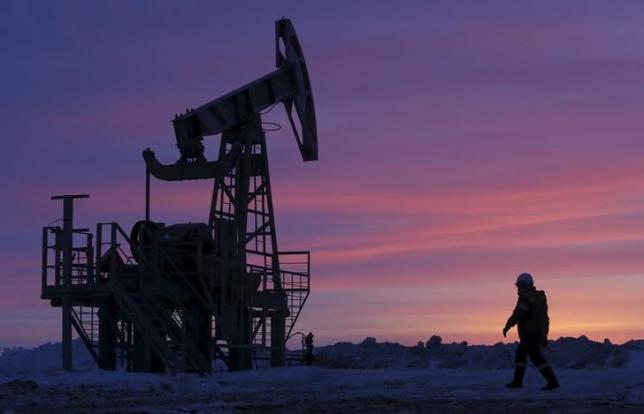
A worker walks past a pump jack on an oil field owned by Bashneft company near the village of Nikolo-Berezovka, northwest from Ufa, Bashkortostan, Russia, in this January 28, 2015 file photo. REUTERS/Sergei Karpukhin/Files
Category:

IEA: oil prices have bottomed out, but growth will not be sharp

(Reuters) Global oil prices appear to have bottomed out and are expected to rise through this year as investment cuts help to reduce a supply glut, a senior analyst at the International Energy Agency said on Tuesday.

Benchmark Brent crude futures LCOc1 were up 44 cents at $37.01 a barrel at 1304 GMT (06:04 EST), the highest in eight weeks. They hit a more than 12-year low of $27.10 on Jan. 20.

“Oil prices appear to have bottomed out,” Neil Atkinson, the new head of IEA’s oil industry and market division, told a seminar in Oslo.

Posted On :
Category:

Billion-Barrel Stockpile May Take Years to Clear

(Bloomberg) Even if Saudi Arabia wins its struggle with U.S. shale producers over market share, it will face a new billion-barrel adversary.

It won’t be regional nemesis Iran, a resurgent Iraq or long-standing competitor Russia. The answer will be more prosaic: Even when overproduction ends, a stockpile surplus of more than 1 billion barrels built up since 2014 will remain, weighing on prices. Inventories will keep accumulating until the end of 2017, the International Energy Agency forecasts, and clearing the glut could take years.

Posted On :
Category:

U.S. shale’s message for OPEC: above $40, we are coming back

(Reuters) For leading U.S. shale oil producers, $40 is the new $70.

Less than a year ago major shale firms were saying they needed oil above $60 a barrel to produce more; now some say they will settle for far less in deciding whether to crank up output after the worst oil price crash in a generation.

Their latest comments highlight the industry’s remarkable resilience, but also serve as a warning to rivals and traders: a retreat in U.S. oil production that would help ease global oversupply and let prices recover may prove shorter than some may have expected.

Posted On :
Consumers should expect oil prices to recover by 2021
Category:

IEA warns consumers of spike in oil prices

(BBC) The International Energy Agency (IEA) is warning consumers not to let cheap oil lull them into a false sense of security amid forecasts of a price spike by 2021. In a report , the IEA said it expects prices to start recovering in 2017. But it forecasts that will be followed by a sharp jump in price as supply shrinks following under-investment by struggling producers.

Brent crude touched a 13-year low of $28.88 a barrel in January. It has since recovered somewhat, but is still far below a high of $115 in June 2014. On Monday the price was up around 4.9% at $34.62.

Posted On :
Category:

U.S. Banks Growing Hesitant To Loan Money To Energy Firms

(oilprice.com) BNP Paribas, France’s largest bank, announced that it would no longer lend money to struggling oil and gas companies in the United States. “Given the current environment in the oil and gas markets and the short to medium term outlook, BNP Paribas has decided to halt the redevelopment of its reserve-based lending business,” BNP said in a statement. The bank will continue to work with its existing borrowers, but won’t lend to new ones.

The French bank was concerned that default rates among energy companies would rise, sources told Reuters. It was the second time that the bank pulled out of lending to energy companies in the U.S. – it sold a unit to Wells Fargo in 2012 before reentering the space in 2014 when oil prices shot into triple-digit territory.

Posted On :
Category:

Molson Coors says weak economy affecting beer sales in oil-producing provinces

(Toronto Sun via Reuters) Oil workers just aren’t drinking like they used to. Molson Coors Brewing Co. blames a sluggish economy for a big drop in beer sales in Alberta, Newfoundland and Labrador, and Saskatchewan. Customers are abandoning higher-priced premium beers for economy brands, the beer giant says.

“The consumer is under pressure,” Stewart Glendinning, chief executive of Molson Coors Canada, said Thursday during a conference call on the company’s fourth-quarter and 2015 results.

“And if you add to that the fact that consumer debt in Canada is at an all-time high, it’s made for quite a difficult recipe in some of those provinces.”

Posted On :
Category:

Oil investment is weakest in 30 years

(CNN) A history of oil’s booms and busts. The oil price crash has squeezed investment in the industry to the weakest levels in 30 years. Capital expenditure on global oil exploration and production is expected to fall 17% in 2016, following a 24% drop in 2015, according to the International Energy Agency’s medium term outlook.

That will be the first time since 1986 that upstream investment has fallen for two consecutive years, the agency said, warning that the collapse could be storing up problems for consumers further down the track.

“It is easy for consumers to be lulled into complacency by ample stocks and low prices today, but they should heed the writing on the wall: the historic investment cuts we are seeing raise the odds of unpleasant oil-security surprises in the not too distant future,” said IEA Executive Director Fatih Birol on Monday.

Posted On :
Category:

Veterans of 1980s oil glut say this price slump, too, will last

(The Fuse) When Sheikh Ali Khalifa al-Sabah of Kuwait thinks about today’s plunging oil prices, his mind drifts back to the mid-1980s, when he was forced to sell some of his country’s crude for as little as $5 a barrel.

As Kuwait’s oil minister at the time, Sheikh Ali had to sell a cargo or two at that price just to keep up cash flow to a country that depended upon oil revenues. “It wasn’t because I wanted to; it was because it was the market price,” he recalls.

“We really had no alternative.”

Posted On :