
Category:

Peak-Oil Predictions Didn’t Pan Out, But Concerns About Supply Persist As Conventional Crude Slides

(International Business Times) At the outset of the global economic meltdown in 2008, the world was already bracing for another crisis: peak oil. Predictions that oil production would soon top out flooded the airwaves, stoking fears of a global oil shortfall and fueling speculation of prices at hundreds of dollars a barrel.

“People have been trying very hard and they can’t increase oil production from here,” Robert Hirsch, an energy analyst, said in a June 2008 segment on CNBC. He projected oil production would peak, and then decline sharply within three to five years. “For somebody to suggest that all of a sudden something magic is going to happen, and there’s going to all of a sudden be an enormous amount of new oil — they don’t understand the problem,” he added.
Posted On :

Oil Production Is Going To Drop And Oil Prices Are Likely To Increase

(peakoilbarrel.com) Rystad Energy , an independent oil and gas consulting services and business intelligence data firm in Oslo, Norway, has online, a wealth of information concerning upstream oil production projects and costs. Some of it is a bit dated but some of their charts date from late 2015.

The two below Rystad charts were published by CNN Money on November 23, 2015. Costs, Overall This is overall or average cost, not marginal cost. It cost Canada $41 to produce a barrel of oil but only cost Russia $17.20. I guess that is why Canada is cutting back but Russia is not. Costs, Breakdown Here is the breakdown between capital expenditures and operational expenditures. Why would the United Kingdom’s operational expenditures be two and one half times those of Norway? After all, they are both drilling basically the same oil field.

Posted On :
Category:

Just 0.1% of Oil Output Halted Due to Low Prices

(Bloomberg) After a year of low oil prices, only 0.1 percent of global production has been curtailed because it’s unprofitable, according to a report from consultants Wood Mackenzie Ltd. that highlights the industry’s resilience.

The analysis, published ahead of an annual oil-industry gathering in London next week, suggests that oil prices will need to drop even more — or stay low for a lot longer — to meaningfully reduce global production. OPEC and major oil companies like BP Plc and Occidental Petroleum Corp. are betting that low oil prices will drive production down, eventually lifting prices. That’s taking longer than expected, in part due to the resilience of the U.S. shale industry and slumping currencies in oil-rich countries, which have lowered production costs in nations from Russia to Brazil.

Posted On :
Category:

Everybody Hurts: Oil Majors, Independents Drastically Cut Capex

(The Fuse) It seems fitting that oil prices fell back under $30 on the day that two major oil companies reported disastrous earnings results showing the damage of the past year and a half. The decline in prices that began in mid-2014 has wreaked havoc across all different types of companies—NOCs, IOCs, independents, oil majors, oilfield services—and there seems to be no respite in the short run. Companies are continuing to lay off staff, cut back on projects, and report eye-opening losses.

Posted On :

Texas Isn’t Scared of $30 Oil, or Is It?

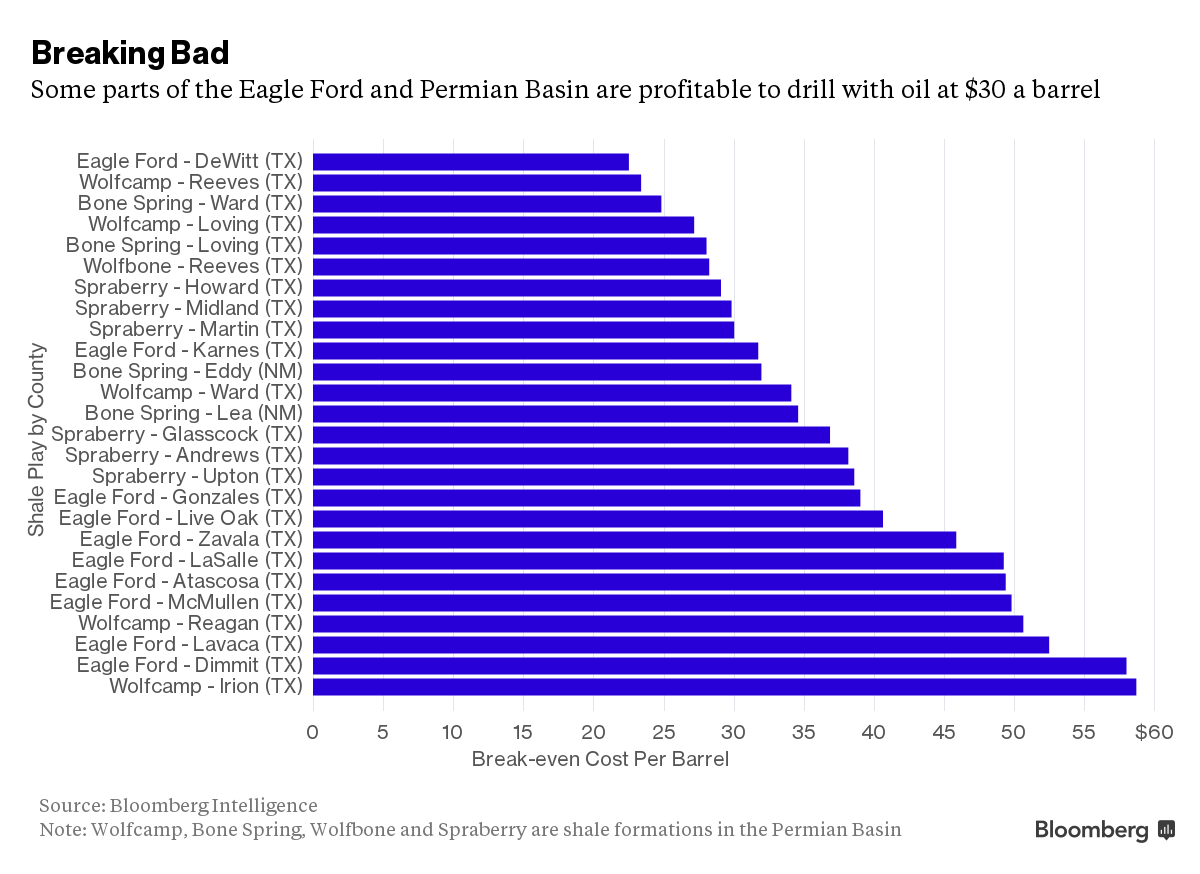
(Bloomberg) Texas has a message for $30 crude doomsayers: Bring it on.

A handful of shale patches in the state, which would be the world’s sixth-largest oil producer if it were a country, are profitable with crude below $30 a barrel, according to an analysis by Bloomberg Intelligence. In DeWitt County, which produced more than 100,000 barrels a day in November from the Eagle Ford formation, the average well can be profitable with U.S. benchmark crude at $22.52 a barrel, $4 below the lowest level this year. Drive 200 miles southwest to Dimmit County, and drillers need $58 oil.

Posted On :
Category:

S&P Lowers Shell’s Rating, Puts Other Oil Majors on Watch

(Bloomberg) The long-term credit rating for the world’s third-largest oil producer by market value was reduced one level to A+, the fifth-highest investment grade, from AA-, and was placed on watch for another possible reduction, the ratings company said in a statement Monday. S&P also assigned a negative outlook to BP Plc, Eni SpA, Repsol SA, Statoil ASA and Total SA.

Oil has fallen more than 70 percent since June 2014. The slump accelerated after Saudi Arabia led the Organization of Petroleum Exporting Countries’ decision in November 2014 to maintain output and defend market share against higher-cost producers including U.S. shale drillers.

Posted On :
Category:

Canadian Oil Industry Starting to Shut In Production as Prices Plunge to $15

(The Fuse) Oil prices plunged to fresh decade-plus lows by mid-January amid concerns over persistent oversupply and the faltering Chinese economy. A growing chorus is projecting oil to drop as far as $25 or $20 per barrel before all is said and done, with some even raising the prospect of sub-$20 oil.

There are some places where oil already passed those lowly depths weeks ago, most notably Canada. While WTI and Brent hover around $30 per barrel, Western Canadian Select (WCS), a benchmark for heavy crude in Canada, has plunged to less than half that level.

Posted On :
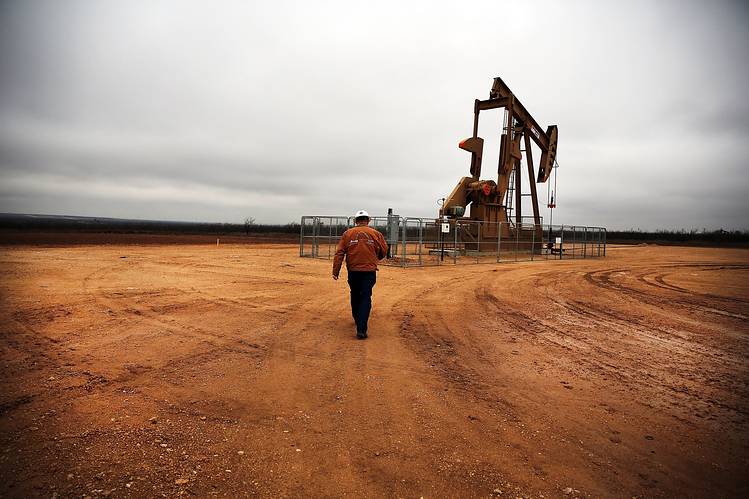
An oil well operated by Apache Corp. in the Permian Basin in Texas. The company fended off an overture by Anadarko last fall.
Category:

Oil Slump Sets Scene for Mergers

(Wall Street Journal) Here’s how bad things are getting in the oil patch: In some cases it is now cheaper for energy companies to buy one another rather than drill for crude.

A year-and-a-half on from the start of the worst crude-oil price crash in a generation, the biggest U.S. and European energy companies have delayed projects and made such deep budget cuts that they will soon struggle to replace the oil they pump out of the ground with new reserves.

Posted On :