Category:

Bankruptcies Hit Alarming Levels in Oilfield Services Sector

(The Fuse) In 2015, almost 40 oilfield services companies, with more than $5 billion in debt, went bankrupt. More are expected this year.

While bankruptcies among independent shale producers have received the most attention , the oilfield services sector is in dire straits. The carnage from the low oil price in the shale patch has been widespread, with companies that provide technology, transportation, and supplies to producers getting slammed.

Posted On :
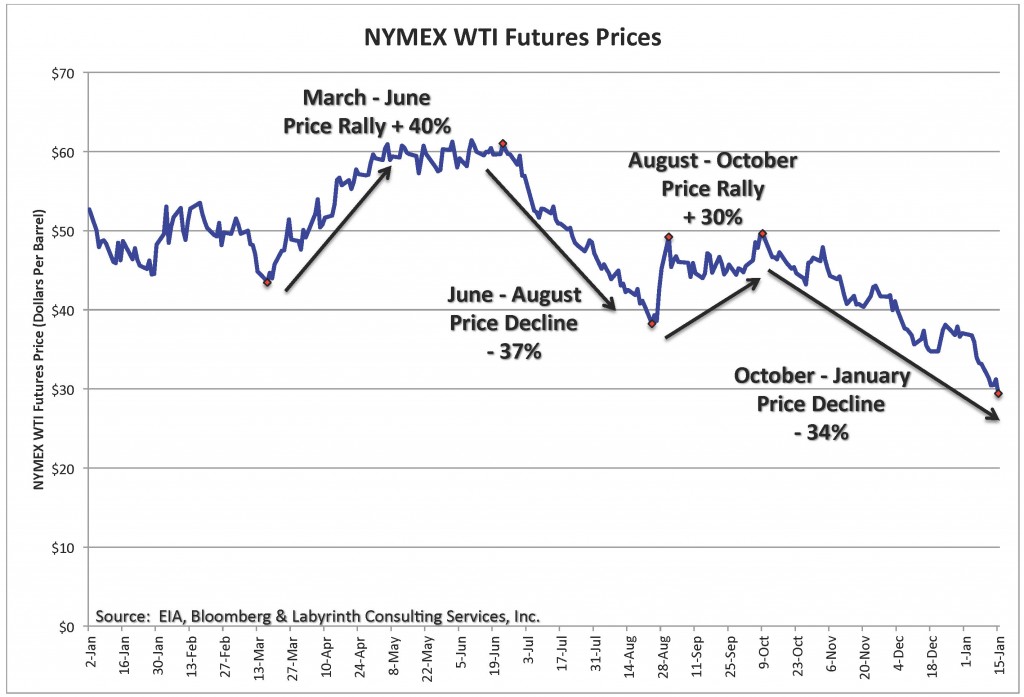
Chart_2015 NYMEX Price Cycles

Fundamentals Point Toward Oil-Market Balance: IEA Too Pessimistic

(artberman.com) Fundamentals point toward market balance but pessimism is dragging oil prices down. IEA has apparently succumbed to this negativity but their data suggests that things are getting better, not worse.

In a business-as-usual world in which nothing unusual happens, the world will be close to market balance some time in 2016. If anything unusual happens, all bets are off and oil prices could rebound much faster than anyone imagines.

Posted On :
Category:

IEA sees global oil glut worsening, OPEC deal unlikely

(Reuters) The world will store unwanted oil for most of 2016 as declines in U.S. output take time and OPEC is unlikely to cut a deal with other producers to reduce ballooning output, the International Energy Agency said.

The agency, which coordinates energy policies of industrialised countries, said that while it did not believe oil prices could follow some of the most extreme forecasts and fall to as low as $10 per barrel, it was equally hard to see how they could rise significantly from current levels.

Posted On :

Research Paper: Oil Price Instability and Policy Uncertainty in an OPEC World

(The Fuse) Two years ago some oil market prognosticators were worried (or happy) that oil could go to $150 a barrel or more. The unexpected collapse in oil prices appears driven by the desire of some OPEC members to reduce competition by opening the spigots. The fall from $115 a barrel to as little as $30 a barrel has discouraged investment in drilling. Oil rig count in the United States is down by two-thirds from its peak. Middle East rig count has not fallen. In this paper we review the rise of U.S. oil production driven by the fracking revolution. Oil price volatility impacts many business sectors and affects federal macroeconomic policy as the Federal Reserve tries to encourage low unemployment and price stability. The history of 40 plus years of oil volatility continues to damage U.S. economic performance.

Posted On :
Category:

Peak Oil Review – 8 Feb 2016

It was a volatile week, with prices falling on Monday and Tuesday due to the oversupply situation and traders deciding that a grand agreement between Russia and OPEC to cut oil production was unlikely. However, prices climbed on Wednesday as talk of the Russia/OPEC deal revived, the US dollar underwent a sudden price drop, and a hedge fund that that held $600 million in short oil futures positions was liquidated. On Thursday and Friday, the markets were back to believing that the Saudis were not going to cut production as Riyadh lowered their prices for oil being sold to Europe and Asia as part of the new competition with Iran. A big jump in US crude and gasoline inventories announced on Wednesday helped with the downward pressure. At week’s end, New York futures closed at $30.89, down 8.1 percent for the week and London closed at $34.06, down 5.4 percent for the week.

Posted On :
Category:

Peak-Oil Predictions Didn’t Pan Out, But Concerns About Supply Persist As Conventional Crude Slides

(International Business Times) At the outset of the global economic meltdown in 2008, the world was already bracing for another crisis: peak oil. Predictions that oil production would soon top out flooded the airwaves, stoking fears of a global oil shortfall and fueling speculation of prices at hundreds of dollars a barrel.

“People have been trying very hard and they can’t increase oil production from here,” Robert Hirsch, an energy analyst, said in a June 2008 segment on CNBC. He projected oil production would peak, and then decline sharply within three to five years. “For somebody to suggest that all of a sudden something magic is going to happen, and there’s going to all of a sudden be an enormous amount of new oil — they don’t understand the problem,” he added.

Posted On :
Costs, Overall

Oil Production Is Going To Drop And Oil Prices Are Likely To Increase

(peakoilbarrel.com) Rystad Energy , an independent oil and gas consulting services and business intelligence data firm in Oslo, Norway, has online, a wealth of information concerning upstream oil production projects and costs. Some of it is a bit dated but some of their charts date from late 2015.

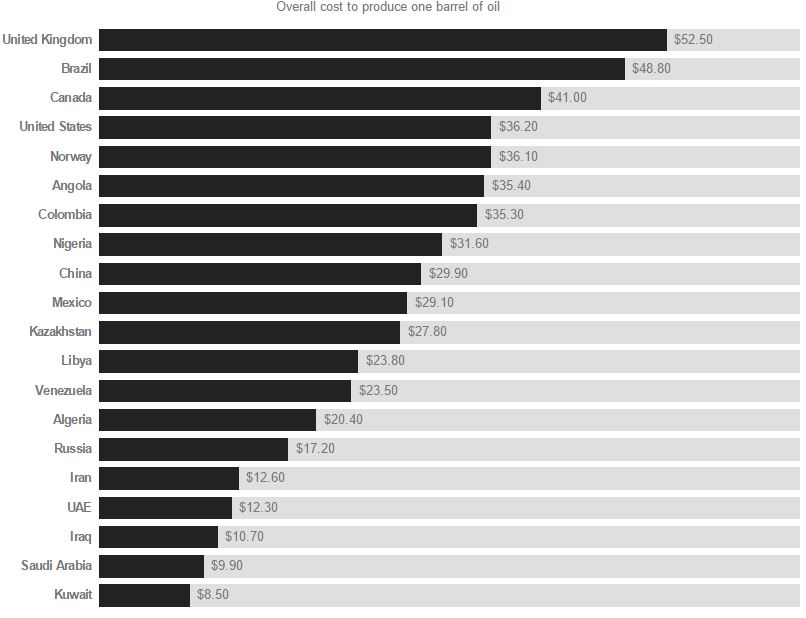
The two below Rystad charts were published by CNN Money on November 23, 2015. Costs, Overall This is overall or average cost, not marginal cost. It cost Canada $41 to produce a barrel of oil but only cost Russia $17.20. I guess that is why Canada is cutting back but Russia is not. Costs, Breakdown Here is the breakdown between capital expenditures and operational expenditures. Why would the United Kingdom’s operational expenditures be two and one half times those of Norway? After all, they are both drilling basically the same oil field.

Posted On :