
Category:

Just 0.1% of Oil Output Halted Due to Low Prices

(Bloomberg) After a year of low oil prices, only 0.1 percent of global production has been curtailed because it’s unprofitable, according to a report from consultants Wood Mackenzie Ltd. that highlights the industry’s resilience.

The analysis, published ahead of an annual oil-industry gathering in London next week, suggests that oil prices will need to drop even more — or stay low for a lot longer — to meaningfully reduce global production. OPEC and major oil companies like BP Plc and Occidental Petroleum Corp. are betting that low oil prices will drive production down, eventually lifting prices. That’s taking longer than expected, in part due to the resilience of the U.S. shale industry and slumping currencies in oil-rich countries, which have lowered production costs in nations from Russia to Brazil.
Posted On :
Category:

Everybody Hurts: Oil Majors, Independents Drastically Cut Capex

(The Fuse) It seems fitting that oil prices fell back under $30 on the day that two major oil companies reported disastrous earnings results showing the damage of the past year and a half. The decline in prices that began in mid-2014 has wreaked havoc across all different types of companies—NOCs, IOCs, independents, oil majors, oilfield services—and there seems to be no respite in the short run. Companies are continuing to lay off staff, cut back on projects, and report eye-opening losses.

Posted On :

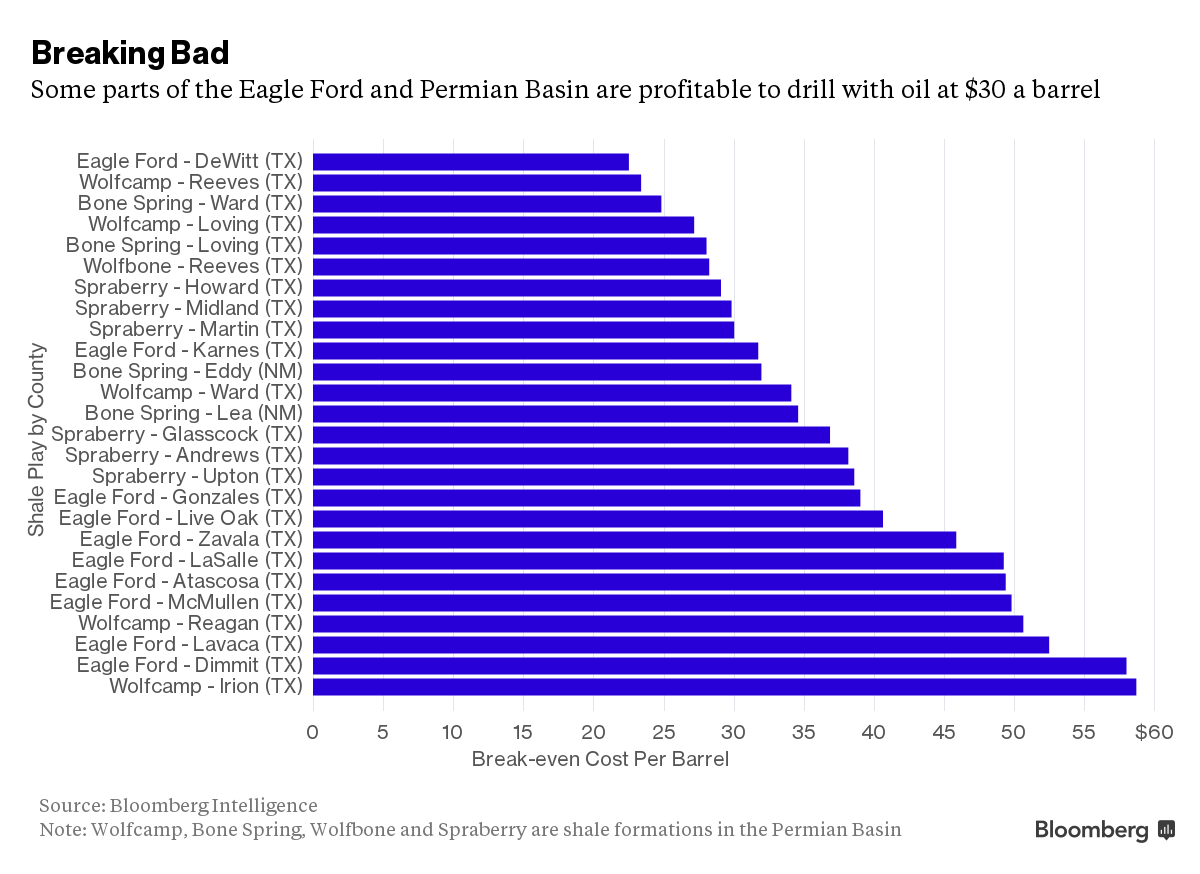
Texas Isn’t Scared of $30 Oil, or Is It?

(Bloomberg) Texas has a message for $30 crude doomsayers: Bring it on.

A handful of shale patches in the state, which would be the world’s sixth-largest oil producer if it were a country, are profitable with crude below $30 a barrel, according to an analysis by Bloomberg Intelligence. In DeWitt County, which produced more than 100,000 barrels a day in November from the Eagle Ford formation, the average well can be profitable with U.S. benchmark crude at $22.52 a barrel, $4 below the lowest level this year. Drive 200 miles southwest to Dimmit County, and drillers need $58 oil.

Posted On :
Category:

S&P Lowers Shell’s Rating, Puts Other Oil Majors on Watch

(Bloomberg) The long-term credit rating for the world’s third-largest oil producer by market value was reduced one level to A+, the fifth-highest investment grade, from AA-, and was placed on watch for another possible reduction, the ratings company said in a statement Monday. S&P also assigned a negative outlook to BP Plc, Eni SpA, Repsol SA, Statoil ASA and Total SA.

Oil has fallen more than 70 percent since June 2014. The slump accelerated after Saudi Arabia led the Organization of Petroleum Exporting Countries’ decision in November 2014 to maintain output and defend market share against higher-cost producers including U.S. shale drillers.

Posted On :
Category:

Quote of the week: Marco Dunand founder and CEO of trading house Mercuria

“The fact that some oil is being sold at $10 per barrel – like some Canadian and Venezuelan crude grades – shows that the strain on producers has rarely been so big. At this level, some producers are not covering capital and operating expenses. And costs are even higher to shut down production. These prices will serve as destabilizing factors in many producing countries and on many bank loans.”

Marco Dunand founder and CEO of trading house Mercuria

Posted On :
Category:

Peak Oil Review – 1 Feb 2016

Last week there was a surge in oil prices based on rumors and statements from Iraq’s oil minister and a Russian pipeline official that Russia and the Saudis might be considering a meeting to discuss “coordination” of their oil production. The merest hint of a supply cut was enough to send traders into a frenzy. Short positions were covered and prices rose from below $30 a barrel to nearly $36 in London. The story was quickly denied by numerous OPEC officials and even by Russia’s deputy prime minister, but oil prices stayed firm closing at $33.62 in New York and $34.74 in London.

Posted On :