Category:

Moody’s analyst on shale downturn

“I’ve covered this industry since the late 70s and I would have to say I haven’t seen a situation like this, of this magnitude. We’ve concluded that this is not a normal cyclical downturn.”

Carol Cowan, a Moody’s senior analyst

“Shale was a hot growth area and companies made the mistake of borrowing too much. It’s amazing that so many people were willing to lend them money. Many are going to file for bankruptcy, and bondholders and equity are going to get wiped out en masse.”

George Schultze, founder and chief investment officer of Schultze Asset Management in New York
Posted On :
Category:

Peak Oil Review – 14 Mar 2016

Oil prices continued to move higher last week closing at $38.50 in New York and $40.39 in London, up 7.2 and 4.3 percent respectively for the week. The two-month surge which has taken oil prices up some 45 percent started with reports in January that Russia and the Saudis were trying to bring major oil producers together to agree on a production freeze. This idea is now fading as Iran adamantly refuses to freeze production and no other exporters seem willing to cede current customers to Tehran. The impetus for the price increase now is focusing on forecasts that low prices could lead to a decline of some 750,000 b/d in non-OPEC oil production this year – mostly in the US. Some of this could, of course, be offset by increased Iranian exports. Tehran had hoped to increase production and exports by 1 million b/d this year but is having difficulty finding customers and increasing production. A weaker US dollar also contributed to the oil price increase last week.

Posted On :

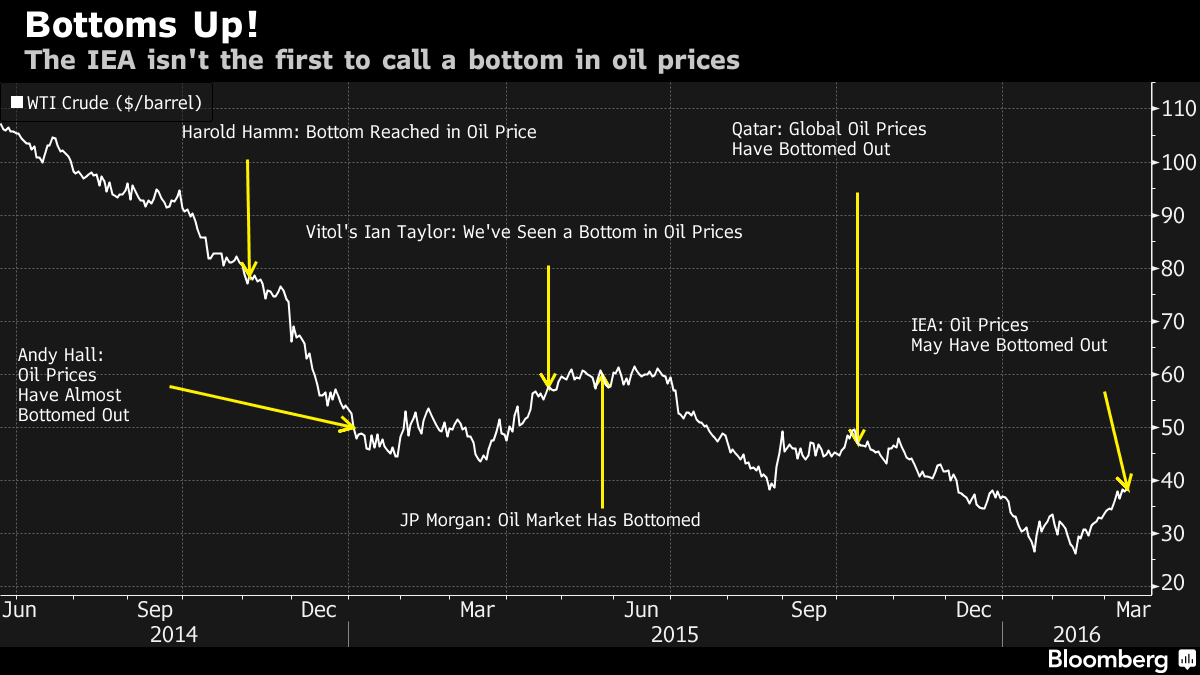
A Short History of Unsuccessfully Calling a Bottom in Oil: Chart

(Bloomberg) The upturn in U.S. core inflation and rise in oil prices are causing money to pour into a trade that was one of Wall Street’s favorites heading into 2016, according to Société Générale SA.

Late in 2015, strategists at Goldman Sachs Group Inc., JPMorgan Chase & Co., and Morgan Stanley—to name a few—were pounding the table on Treasury inflation-protected securities, based on the belief that market-based measures of price pressures over the medium term were far too subdued.

Posted On :
Category:

The Shale Reckoning Comes to Oklahoma

(Bloomberg) In January 2012, I traveled to Oklahoma City for the first time to report on what was considered a surprising development: a U.S. oil boom. Until then, hydraulic fracturing—aka fracking—was best known for boosting U.S. natural gas production. It was just starting to be used to unlock oil trapped in deep underground layers of rock like the Bakken Shale in North Dakota, the Eagle Ford in Texas, and the Mississippi Lime in Oklahoma.

Posted On :

The Long Term Impact Of The Oil Rig Crash

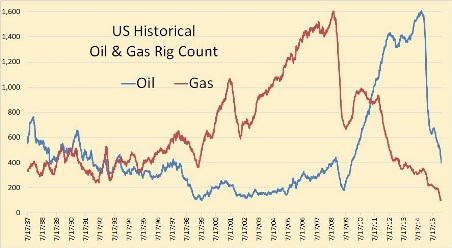
(oilprice.com) The North American Baker Hughes Rig Count came out Friday. The decline continues. Baker Hughes gives an oil and gas breakout for every basin and state with five years of historical data. Baker Hughes has twenty eight and one half years of historical data for total U.S. rigs but only five years for individual basins. Gas rigs peaked in August 2008 at 1,606 rigs, over six years before the peak in Oil rigs. On February, 26, gas total U.S. gas rig count stood at 102, a decline of over 93 percent. A closer look at the total U.S. total rig count.

October 10, 2014 1,609 rigs
February 26, 2016 400 rigs
Percent decline 75 percent

Posted On :

Oil Prices Should Fall, Possibly Hard

(Forbes) Oil prices should fall, possibly hard, in coming weeks. That is because fundamentals do not support the present price.

Prices should fall to around $30 once the empty nature of an OPEC-plus-Russia production freeze is understood. A return to the grim reality of over-supply and the weakness of the world economy could push prices well into the $20s.

Posted On :
Category:

Luisa Palacios, head of Latin America at Medley Global Advisors, a risk consultancy

About Latin America: “The 70 percent drop in prices is a major shock. Oil was contributing in some countries from 20 to 50 per cent government revenues and 50 to 96 percent of exports. No wonder we are starting to question the financial viability of some countries and some national oil companies.”

Luisa Palacios, head of Latin America at Medley Global Advisors, a risk consultancy

Posted On :
Category:

Peak Oil Review – 7 Mar 2016

Oil prices rose for the third consecutive week with New York futures closing at $35.92 a barrel and London at $38.72. Prices in London are now up 3.9 percent for the year. Behind the price rise is a continuing drop in the number of drilling rigs operating in the US and the announcement by several major shale oil producers that they plan to suspend new drilling until prices recover. Exactly where profitability is these days is in dispute with some drillers contending they can make money from shale oil if prices rise into the mid- $40s as compared to $60-70 two years ago. Some of these claims are for the benefit of the banks who have become very wary of the oil industry in recent months. The downside, of course, is that if shale oil producers start increasing production if prices get into the mid-$40s, they could easily drive them back down again with unsaleable production.

Posted On :
Category:

Shale Oil Industry Announces Production Declines Across the Board

(The Fuse) The U.S. oil industry seemed to be defying gravity in 2015, keeping oil production elevated even as oil prices crashed to lows not seen in more than a decade. But now, over 1.5 years into the price collapse, production declines in shale oil are finally starting to appear as low oil prices have slashed company investments in new supply, and production begins to decline from existing wells.

The latest data from the EIA shows that U.S. output is steadily declining, although perhaps at a slower rate than shale’s competitors might prefer. In December, the latest month for which final data is available, total U.S. production declined to 9.26 million barrels per day (mbd), a loss of 43,000 barrels per day from the month before and down from a peak of 9.69 mbd in April 2015. But December’s small decline hides the decrease in shale production, as losses were offset by output increases from the Gulf of Mexico.

Posted On :