The Long Term Impact Of The Oil Rig Crash

(oilprice.com) The North American Baker Hughes Rig Count came out Friday. The decline continues. Baker Hughes gives an oil and gas breakout for every basin and state with five years of historical data. Baker Hughes has twenty eight and one half years of historical data for total U.S. rigs but only five years for individual basins. Gas rigs peaked in August 2008 at 1,606 rigs, over six years before the peak in Oil rigs. On February, 26, gas total U.S. gas rig count stood at 102, a decline of over 93 percent. A closer look at the total U.S. total rig count.

October 10, 2014 1,609 rigs
February 26, 2016 400 rigs
Percent decline 75 percent
Posted On :

Oil Prices Should Fall, Possibly Hard

(Forbes) Oil prices should fall, possibly hard, in coming weeks. That is because fundamentals do not support the present price.

Prices should fall to around $30 once the empty nature of an OPEC-plus-Russia production freeze is understood. A return to the grim reality of over-supply and the weakness of the world economy could push prices well into the $20s.

Posted On :
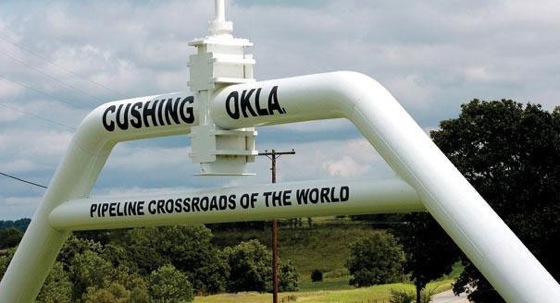
Cushing-oklahoma-tank-farm

What Really Controls Oil Prices?

(Forbes) World oil prices are controlled by the amount of crude oil stored at Cushing, Oklahoma. That’s because Cushing is the pricing point for WTI (West Texas Intermediate) oil prices, the most-traded oil futures contract in the world.

Cushing Storage Rules World Oil Prices.

WTI (and Brent) oil prices have good negative correlation with the volume of crude oil stored at Cushing.

Posted On :

Why Oil Booms And Busts Happen

(oilprice.com) What if I told you that there was a period in history where oil demand declined by 5 million barrels per day and non-OPEC supply increased by 5 million barrels per day, yet oil price rallied more than 50 percent? Would you believe me?

If your answer is yes, then you guessed right. This was the period from 1979 to 1985; it was a period during which global oil demand declined from over 61 million barrels to 56 million barrels and non-OPEC supply increased from 32 million barrels to 37 million barrels. Yet prices rallied from $17 a barrel in 1979 to $26 a barrel in 1985, while reaching as high as $35 in 1981.

Posted On :

Oil Price And Its Effect On Production

(peakoilbarrel.com) The JODI Oil World Database came out a few days ago. The data is through December 2015. The JODI C+C production numbers differs somewhat from the EIA numbers. The JODI OPEC numbers are crude. Also there are a few very small producers that do not report to JODI so their numbers will be slightly less than the EIA. But otherwise they are pretty accurate.

Also, JODI, for some reason, does not count all of Canada’s oil sands production. So for Canada I use Canada’s National Energy Board numbers instead.

Posted On :

Why Oil Fell To $30

(Forbes) One of the questions I am most frequently asked is “What factors led to the precipitous drop in oil prices?” Some have suggested that this is all OPEC’s fault, while others have blamed either surging U.S. shale oil production or falling demand.

I addressed the demand issue back in December in The Fallacy of Peak Oil Demand . To summarize, since 1983, annual global demand for crude oil has only fallen twice; a small decline in 1985 and another decline in 2009 in response to the financial crisis. The growth rate for crude oil has been remarkably consistent, adding an average of almost exactly a million barrels per day (bpd) for more than 30 years.

Posted On :

Texas Oil Production Still on a Plateau

(peakoilbarrel.com) The Texas RRC Oil and Gas Production Data is out. There appeared to be no decline in December production and may have even been a slight increase.

The Texas RRC data is incomplete and only gives an indication as to whether Texas production increased or decreased. The data appears to droop because each month the the Texas Railroad Commission receives a little more data and the totals increase, little by little, month by month, until after many months the data is complete.

Posted On :

Is Saudi Arabia Winning The War Against Shale?

(Rigzone) Saudi officials insist the kingdom’s oil production strategy is not aimed at putting U.S. shale producers out of business, a message that has been repeated to visiting U.S. policymakers.

The United States remains the kingdom’s most important security partner, and Saudi officials do not want to be seen to be deliberately trying to halt the shale revolution.

Posted On :
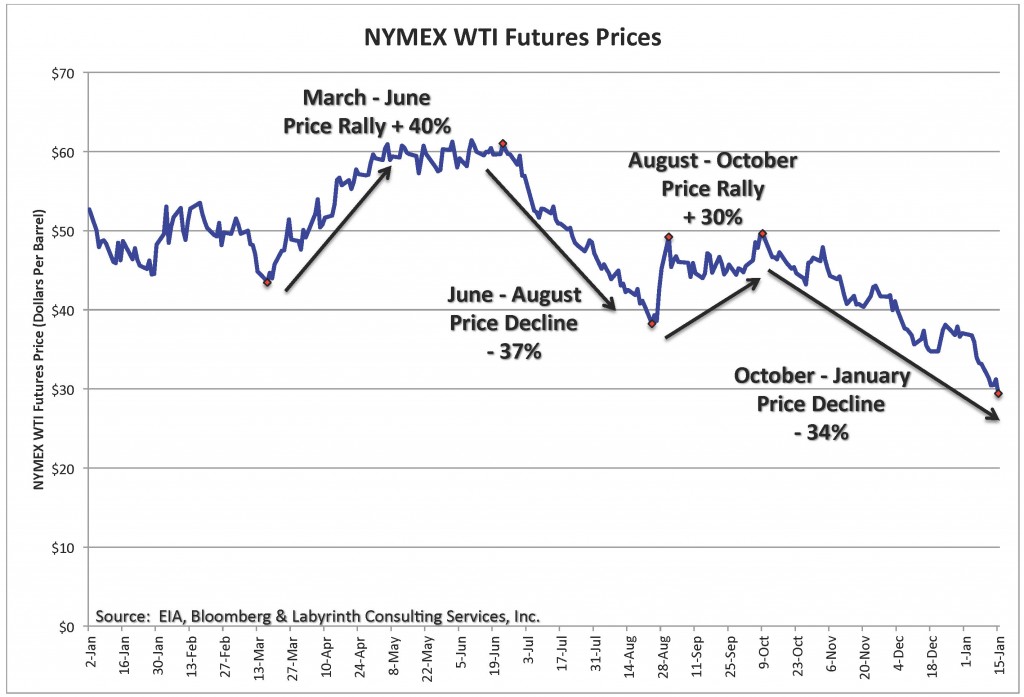
Chart_2015 NYMEX Price Cycles

Fundamentals Point Toward Oil-Market Balance: IEA Too Pessimistic

(artberman.com) Fundamentals point toward market balance but pessimism is dragging oil prices down. IEA has apparently succumbed to this negativity but their data suggests that things are getting better, not worse.

In a business-as-usual world in which nothing unusual happens, the world will be close to market balance some time in 2016. If anything unusual happens, all bets are off and oil prices could rebound much faster than anyone imagines.

Posted On :

Research Paper: Oil Price Instability and Policy Uncertainty in an OPEC World

(The Fuse) Two years ago some oil market prognosticators were worried (or happy) that oil could go to $150 a barrel or more. The unexpected collapse in oil prices appears driven by the desire of some OPEC members to reduce competition by opening the spigots. The fall from $115 a barrel to as little as $30 a barrel has discouraged investment in drilling. Oil rig count in the United States is down by two-thirds from its peak. Middle East rig count has not fallen. In this paper we review the rise of U.S. oil production driven by the fracking revolution. Oil price volatility impacts many business sectors and affects federal macroeconomic policy as the Federal Reserve tries to encourage low unemployment and price stability. The history of 40 plus years of oil volatility continues to damage U.S. economic performance.

Posted On :