
Category:

IEA Reiterates Underinvestment Risk

(The Fuse) Today at IHS CERAWeek in Houston, Texas, the International Energy Agency (IEA) released the 2016 Medium Term Oil Market Report, urging that consumer countries not be drawn into a false sense of complacency given the current low prices and the global glut in supply—even as the likelihood of a price spike in the medium-term remain slim. Last year, oil capital expenditures (capex) declined by 24 percent, and this year we expect an additional 17 percent. This is historic, because in the last 30 years we have never seen oil investment decline in two consecutive years. “It is easy for consumers to be lulled into complacency by ample stocks and low prices today, but they should heed the writing on the wall,” said IEA Executive Director Fatih Birol.
Posted On :
Category:

Oil Glut Will Persist Into 2017 as IEA Sees Prices Capped

(Bloomberg) The global oil glut will persist into 2017, limiting any chance of a price rebound in the short term as the surplus takes even longer to clear than previously estimated, according to the International Energy Agency.

While U.S. shale oil production will retreat this year and next as the price slump hits drilling, its subsequent recovery will ensure America remains the biggest source of new supply to 2021.

Posted On :
oilfieldbankruptcies1
Category:

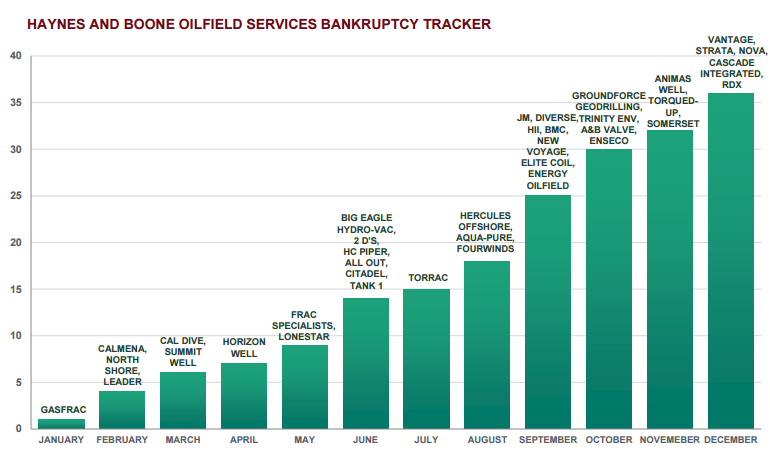
Bankruptcies Hit Alarming Levels in Oilfield Services Sector

(The Fuse) In 2015, almost 40 oilfield services companies, with more than $5 billion in debt, went bankrupt. More are expected this year.

While bankruptcies among independent shale producers have received the most attention , the oilfield services sector is in dire straits. The carnage from the low oil price in the shale patch has been widespread, with companies that provide technology, transportation, and supplies to producers getting slammed.

Posted On :
Category:

IEA sees global oil glut worsening, OPEC deal unlikely

(Reuters) The world will store unwanted oil for most of 2016 as declines in U.S. output take time and OPEC is unlikely to cut a deal with other producers to reduce ballooning output, the International Energy Agency said.

The agency, which coordinates energy policies of industrialised countries, said that while it did not believe oil prices could follow some of the most extreme forecasts and fall to as low as $10 per barrel, it was equally hard to see how they could rise significantly from current levels.

Posted On :
Category:

Peak-Oil Predictions Didn’t Pan Out, But Concerns About Supply Persist As Conventional Crude Slides

(International Business Times) At the outset of the global economic meltdown in 2008, the world was already bracing for another crisis: peak oil. Predictions that oil production would soon top out flooded the airwaves, stoking fears of a global oil shortfall and fueling speculation of prices at hundreds of dollars a barrel.

“People have been trying very hard and they can’t increase oil production from here,” Robert Hirsch, an energy analyst, said in a June 2008 segment on CNBC. He projected oil production would peak, and then decline sharply within three to five years. “For somebody to suggest that all of a sudden something magic is going to happen, and there’s going to all of a sudden be an enormous amount of new oil — they don’t understand the problem,” he added.

Posted On :
Category:

Just 0.1% of Oil Output Halted Due to Low Prices

(Bloomberg) After a year of low oil prices, only 0.1 percent of global production has been curtailed because it’s unprofitable, according to a report from consultants Wood Mackenzie Ltd. that highlights the industry’s resilience.

The analysis, published ahead of an annual oil-industry gathering in London next week, suggests that oil prices will need to drop even more — or stay low for a lot longer — to meaningfully reduce global production. OPEC and major oil companies like BP Plc and Occidental Petroleum Corp. are betting that low oil prices will drive production down, eventually lifting prices. That’s taking longer than expected, in part due to the resilience of the U.S. shale industry and slumping currencies in oil-rich countries, which have lowered production costs in nations from Russia to Brazil.

Posted On :
Category:

Everybody Hurts: Oil Majors, Independents Drastically Cut Capex

(The Fuse) It seems fitting that oil prices fell back under $30 on the day that two major oil companies reported disastrous earnings results showing the damage of the past year and a half. The decline in prices that began in mid-2014 has wreaked havoc across all different types of companies—NOCs, IOCs, independents, oil majors, oilfield services—and there seems to be no respite in the short run. Companies are continuing to lay off staff, cut back on projects, and report eye-opening losses.

Posted On :
Category:

S&P Lowers Shell’s Rating, Puts Other Oil Majors on Watch

(Bloomberg) The long-term credit rating for the world’s third-largest oil producer by market value was reduced one level to A+, the fifth-highest investment grade, from AA-, and was placed on watch for another possible reduction, the ratings company said in a statement Monday. S&P also assigned a negative outlook to BP Plc, Eni SpA, Repsol SA, Statoil ASA and Total SA.

Oil has fallen more than 70 percent since June 2014. The slump accelerated after Saudi Arabia led the Organization of Petroleum Exporting Countries’ decision in November 2014 to maintain output and defend market share against higher-cost producers including U.S. shale drillers.

Posted On :
Category:

Canadian Oil Industry Starting to Shut In Production as Prices Plunge to $15

(The Fuse) Oil prices plunged to fresh decade-plus lows by mid-January amid concerns over persistent oversupply and the faltering Chinese economy. A growing chorus is projecting oil to drop as far as $25 or $20 per barrel before all is said and done, with some even raising the prospect of sub-$20 oil.

There are some places where oil already passed those lowly depths weeks ago, most notably Canada. While WTI and Brent hover around $30 per barrel, Western Canadian Select (WCS), a benchmark for heavy crude in Canada, has plunged to less than half that level.

Posted On :