In Shift, Obama Won’t Open Southeast Atlantic Coast to Drilling

(NY Times) When the Obama administration unveiled a proposal in January 2015 to open the southeastern Atlantic coast to oil and gas drilling for the first time, environmental advocates were shocked and enraged — and the oil industry was delighted.

The emotions were the same, just on opposite sides of the energy-environmental divide, when the Interior Department announced Tuesday that the administration was yanking Atlantic drilling off the table. And almost everyone was shocked.
Posted On :
Category:

Investors Increasingly Bullish on Energy Sector

(NY Times) It was one of the darkest periods of the oil market slump. The global economy was showing fresh signs of slowing, and crude prices were collapsing so steeply that virtually every well in America was unprofitable.

But when Diamondback Energy went out to raise $226 million worth of new stock that week in the middle of January, the oil and gas company found more buyers than it could accommodate. It had to nearly double the amount of shares it sold, to four million.

Posted On :
Category:

If Oil Prices Have Hit Bottom, the Top May Not Be Too Far Away

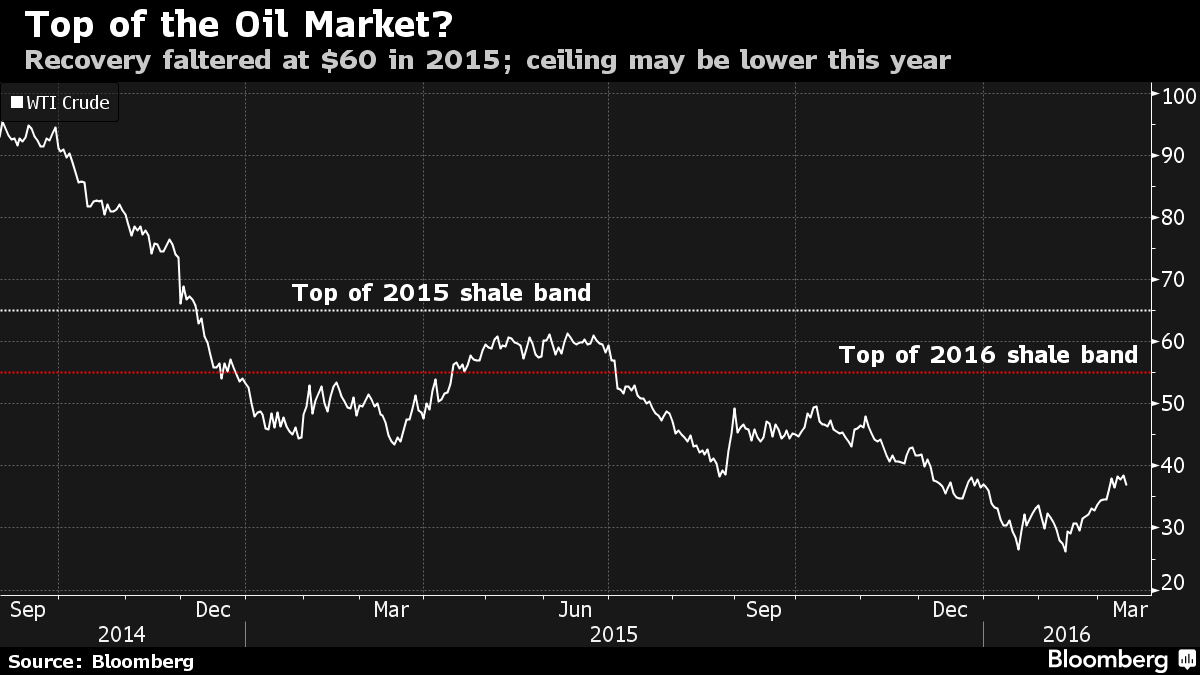
(Bloomberg) The top of the oil market may be closer than you think.

With Brent futures having bounced back as high as $41 a barrel, the International Energy Agency sees “ light at the end of the tunnel ,” and Goldman Sachs Group Inc. is spotting “green shoots.” Even so, many analysts warn that, like the failed rally last year, this recovery will sputter once prices go high enough to keep U.S. crude flowing.

Posted On :

A Short History of Unsuccessfully Calling a Bottom in Oil: Chart

(Bloomberg) The upturn in U.S. core inflation and rise in oil prices are causing money to pour into a trade that was one of Wall Street’s favorites heading into 2016, according to Société Générale SA.

Late in 2015, strategists at Goldman Sachs Group Inc., JPMorgan Chase & Co., and Morgan Stanley—to name a few—were pounding the table on Treasury inflation-protected securities, based on the belief that market-based measures of price pressures over the medium term were far too subdued.

Posted On :
Category:

The Shale Reckoning Comes to Oklahoma

(Bloomberg) In January 2012, I traveled to Oklahoma City for the first time to report on what was considered a surprising development: a U.S. oil boom. Until then, hydraulic fracturing—aka fracking—was best known for boosting U.S. natural gas production. It was just starting to be used to unlock oil trapped in deep underground layers of rock like the Bakken Shale in North Dakota, the Eagle Ford in Texas, and the Mississippi Lime in Oklahoma.

Posted On :

The Long Term Impact Of The Oil Rig Crash

(oilprice.com) The North American Baker Hughes Rig Count came out Friday. The decline continues. Baker Hughes gives an oil and gas breakout for every basin and state with five years of historical data. Baker Hughes has twenty eight and one half years of historical data for total U.S. rigs but only five years for individual basins. Gas rigs peaked in August 2008 at 1,606 rigs, over six years before the peak in Oil rigs. On February, 26, gas total U.S. gas rig count stood at 102, a decline of over 93 percent. A closer look at the total U.S. total rig count.

October 10, 2014 1,609 rigs
February 26, 2016 400 rigs
Percent decline 75 percent

Posted On :

Oil Prices Should Fall, Possibly Hard

(Forbes) Oil prices should fall, possibly hard, in coming weeks. That is because fundamentals do not support the present price.

Prices should fall to around $30 once the empty nature of an OPEC-plus-Russia production freeze is understood. A return to the grim reality of over-supply and the weakness of the world economy could push prices well into the $20s.

Posted On :
bakken production
Category:

Shale Oil Industry Announces Production Declines Across the Board

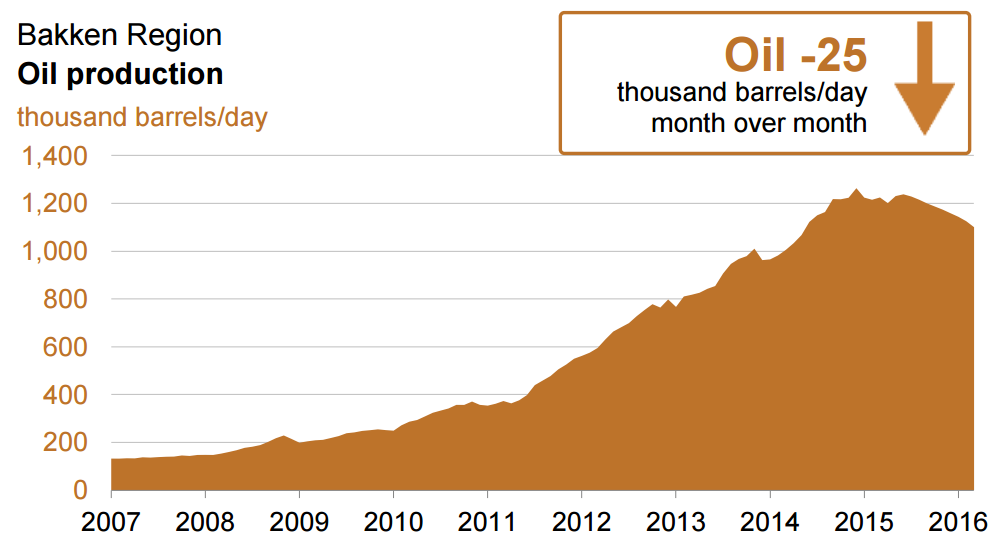
(The Fuse) The U.S. oil industry seemed to be defying gravity in 2015, keeping oil production elevated even as oil prices crashed to lows not seen in more than a decade. But now, over 1.5 years into the price collapse, production declines in shale oil are finally starting to appear as low oil prices have slashed company investments in new supply, and production begins to decline from existing wells.

The latest data from the EIA shows that U.S. output is steadily declining, although perhaps at a slower rate than shale’s competitors might prefer. In December, the latest month for which final data is available, total U.S. production declined to 9.26 million barrels per day (mbd), a loss of 43,000 barrels per day from the month before and down from a peak of 9.69 mbd in April 2015. But December’s small decline hides the decrease in shale production, as losses were offset by output increases from the Gulf of Mexico.

Posted On :
Category:

IEA: oil prices have bottomed out, but growth will not be sharp

(Reuters) Global oil prices appear to have bottomed out and are expected to rise through this year as investment cuts help to reduce a supply glut, a senior analyst at the International Energy Agency said on Tuesday.

Benchmark Brent crude futures LCOc1 were up 44 cents at $37.01 a barrel at 1304 GMT (06:04 EST), the highest in eight weeks. They hit a more than 12-year low of $27.10 on Jan. 20.

“Oil prices appear to have bottomed out,” Neil Atkinson, the new head of IEA’s oil industry and market division, told a seminar in Oslo.

Posted On :